Biologic treatments are the standard of care for moderate-severe ulcerative colitis (UC) and Crohn’s disease (CD), with several mechanisms of action available that work on different points in the inflammatory cascade process. Historically, there had been a choice between products that were administered intravenously or via self-administered injector pens; however, the advent of more sophisticated oral therapies over the last decade has offered new dimensions to longstanding treatment paradigms.
In Europe and Japan, 2018 saw the approval of the first oral JAK inhibitor in UC, tofacitinib. Over the course of 2021 - 2023, additional oral JAK inhibitor options entered these markets, as well as a new mechanism of action delivered via the traditional injectable route to treat CD. With all these changes in a relatively short space of time – and with oral S1P receptor modulators on the horizon – those in the industry were eager to understand their impact on IBD management and how to prepare for future market shifts.
Using data from Ipsos’ IBD Therapy Monitor, we analyse a selection of key physician-stated and real-world patient metrics captured during the course of these new entries, both across the EU4+UK and Japan. While the EU4+UK report focuses on the advanced therapy market, the Japan reports offers insights into both the advanced and non-advanced therapy domains, thus providing a holistic picture of the IBD treatment paradigms and their interplays in this region, and the impact new oral therapies have had on both.
Insights shared from this analysis provide the reader with a top-level overview of key strategic touchpoints to consider when planning for launch of a new asset or defending an existing asset in the IBD treatment market.
- Therapy usage grouped by administration route (SC vs IV vs oral) from Q1 2019 - Q1 2022 (EU+UK) and Q1 2021 - Q3 2025 (Japan), to analyse market trends
- Stated physician caseload to quantify top-level opportunity for further advanced therapy penetration
- Basic patient profiling to identify potential target audiences and unmet needs, including those for products with different routes of administration
- Insights from one consistent, long-established and robust data source
- Physician-stated and real-world patient findings blended for a holistic view
- Curated by Ipsos’ dedicated Immunology experts
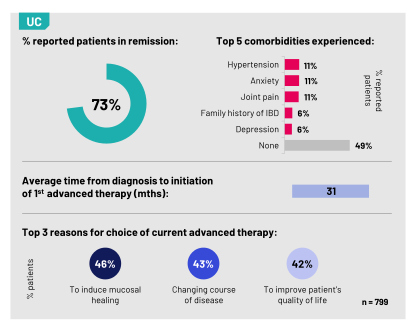
Sample excerpt from report
- 10 slides each for EU+UK and Japan
- Data collection timeframe: Q1 2019-Q1 2022 (EU+UK); Q1 2021 - Q3 2025 (Japan)
- Data source: Ipsos IBD Therapy Monitor
- Respondent type: HCPs, patient record forms
- Regions shown: Aggregate of France, Germany, Italy, Spain, UK; separate report for Japan
- Consistent global data, large-scale datasets